
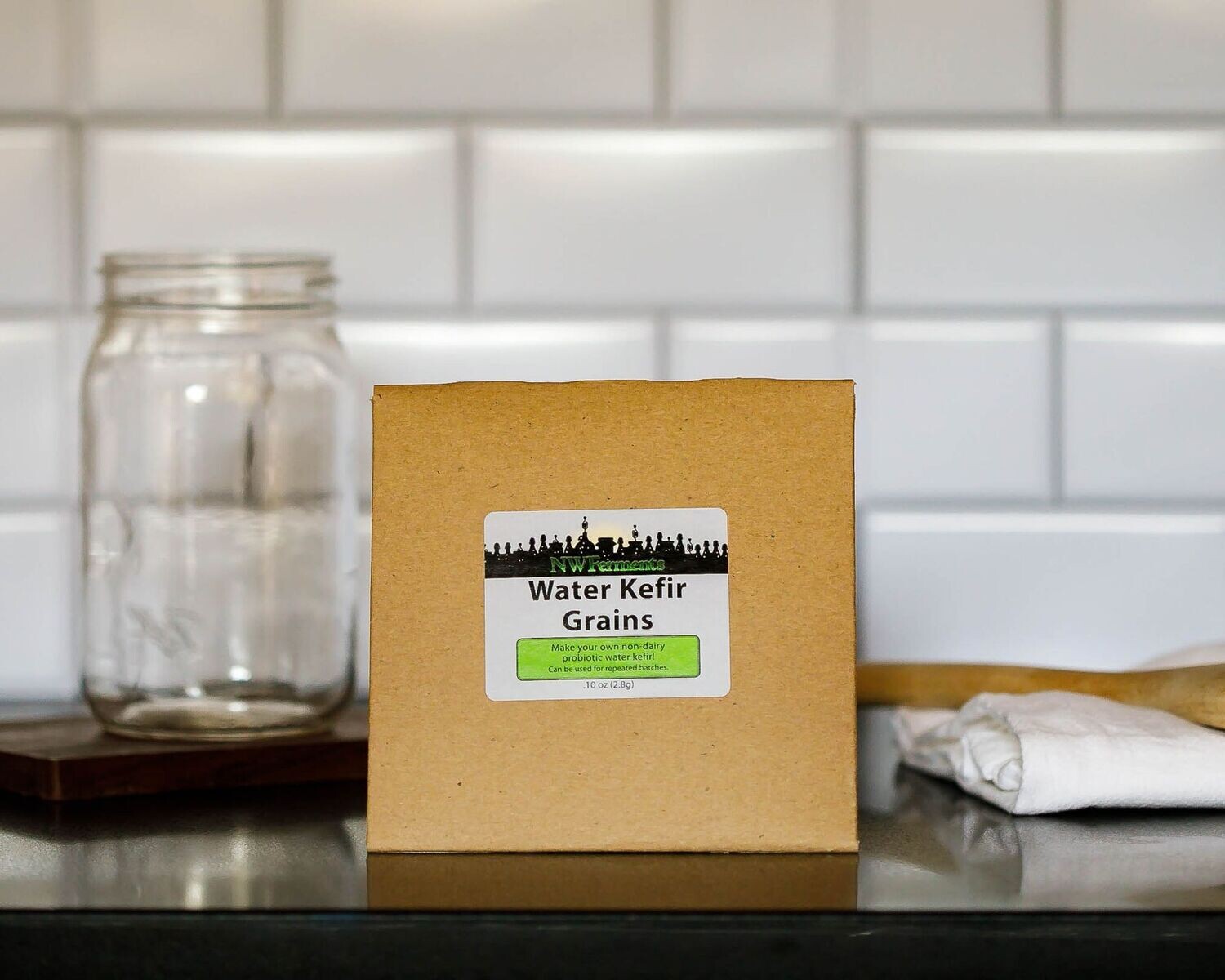
Description
You will need:
- one quart canning jar or other glass jar
- coffee filter or paper towel to cover jar, and elastic
- band to secure cover
- fine mesh plastic strainer (no metal)
- wooden or plastic spoon
- 1/ 4 cup sugar (unbleached evaporated cane sugar works best)
- 3 cups water (filtered, spring or well water is ideal)
- Water Kefir grains
Notes on sugar: Water Kefir grains do like to have a bit of mineral content in the liquid. With spring or well water, the minerals are present. With tap or filtered water, many of the minerals are removed. You can use molasses, rapadura, or other minimally refined sugars as a supplement to replace those minerals. Be sure not to use too much, as over mineralization can also be a problem.
Directions:
1) Heat one cup of the water. Put it in the jar and stir in the sugar until thoroughly dissolved. Add the rest of the water and stir again.
2) Add the Water Kefir grains to the sugar water. Cover & secure with elastic band. Allow to culture at room temp (68° to 78° F. is ideal). Choose a draft-free spot, away from direct sunlight, where the jar won’t be disturbed. Dehydrated grains will take 3 to 5 days to rehydrate, live grains will be ready in 2 days.
3) When the dehydrated grains are plump & translucent, they are ready to make Water Kefir. Strain the grains from the liquid, using a plastic strainer. The first batch may have an off flavor when rehydrating- if so, it can be discarded.
4) For your next batch of Water Kefir, put the grains into fresh sugar water, following the same instructions. Let culture for 2 days. Longer culture times make a more sour product, shorter times make a sweeter product. As your grains increase in volume, you can move up to a larger container. Just use the same ratios: 1/4 c. sugar per quart. The more grains in the jar, the faster it will ferment.
There are many ways to flavor and use your Water Kefir. Check out our instructions for a Second Fermentation.
Ingredients:
organic sugar and molasses, water kefir culture
Probiotic bacteria found: Lactobacillus, Streptococcus, Pediococcus, and Leuconostoc, with yeasts from Saccharomyces, Candida, and Kloeckera.